Attention: Alertness (ALERT) Module
Model 65310
The ALERT training program trains the alertness dimension of attention - the ability to temporarily increase and sustain the intensity of attention.
Setting and Task
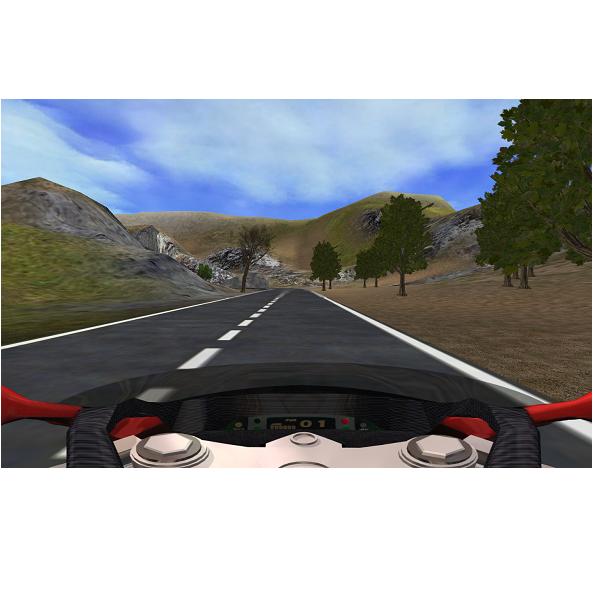
A motorcycle is driven along a winding road. The subject's task is to carefully observe the stretch of road in front of him and to press the reaction key as quickly as possible when obstacles appear. If he reacts in time the motorcycle slows down and the obstacle disappears so that the rider can continue on his way. If he reacts too late there is a collision, represented by the sounds of a crash and a cloud of dust which have a negative reinforcement function.
Theory
When the intensity of attention is temporarily aroused exogenously by a warning signal, phasic alertness is involved. If the arousal occurs without a cue, the situation involves intrinsic alertness. The aim of alertness training must be to improve the intrinsic alertness, since only then the arousal is controlled entirely by the subject - that is, it is cognitively controlled. Where there are deficits related to alertness it is necessary to first improve phasic alertness and only then to proceed to working on intrinsic alertness.
Training Forms
The ALERT training program consists of two training forms. The S1 training form trains phasic alertness, while the S2 training form trains intrinsic alertness. In the S1 training form the obstacles designed to externally arouse the subject's attention are preceded by acoustic and visual warning signals. In the S2 training form the acoustic and visual warning signals are omitted. The motorcycle then travels through a foggy night-time landscape in which the obstacles suddenly appear out of the mist.
Difficulty Structure
Each of the two training forms is made up of 18 levels of difficulty. The degree of challenge is increased by shortening the maximum permitted reaction time. At the first level the subject has 1.8 seconds in which to react to an obstacle, but at the highest level only 0.3 seconds elapse between the sudden appearance of an obstacle and the collision. At the first session the speed of the client's initial reactions is assessed and he is assigned to a difficulty level appropriate to his ability. This ensures that from the outset the training program is optimally adapted to the client's ability and is never either too easy or too difficult for him.
Note
The ALERT training program can also be used with patients with impairments of the visual field. The instruction pages are then displayed on only one half of the screen and the obstacles, too, appear on only one side (for example, trees fall across the carriageway only from the right-hand side).